Wednesday, April 18, 2012
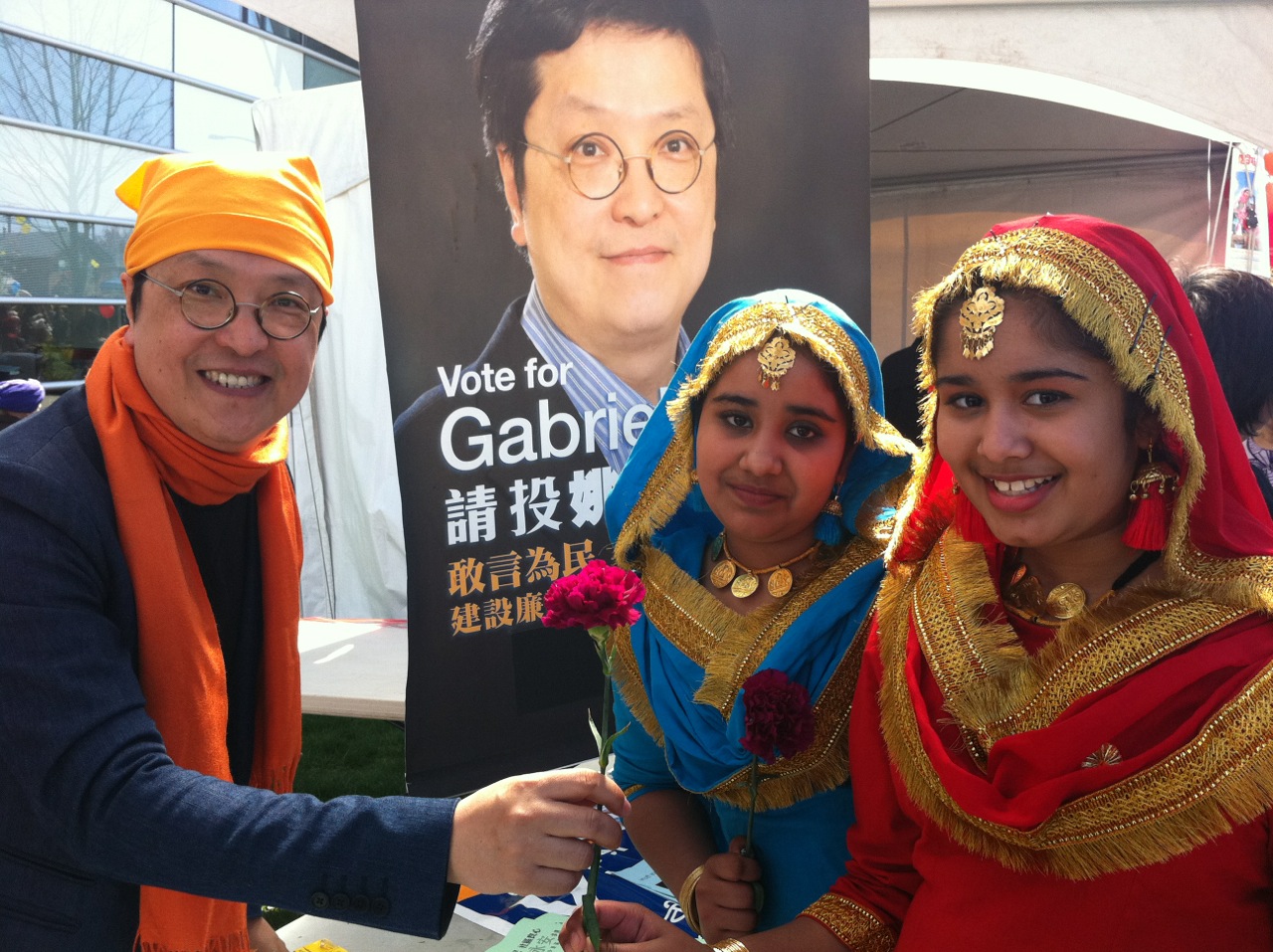
Gabriel Yiu at Vancouver Vaisakhi
Following his call last week, with temple leader Sohan Singh Deo, to invite non-Sikh communities to participate in the Vancouver Vaisakhi, Gabriel Yiu took the lead and set up his own tent at the event. Distributing Chinese snacks, candies, drinks and carnations, and chatting with all who stopped by, the day was a great success. This cheerful photo with Yiu giving carnations to two lovely girls dressed in traditional outfits, was taken by Sukh Johal.

Thursday, April 12, 2012
Media Release: Khalsa Diwan Society President Sohan Singh Deo and Gabriel Yiu Open Ross St. Temple to Chinese Media
(Vancouver) For the first time ever, the doors of the Ross St. Temple were opened to the Chinese media where Khalsa Diwan Society president Sohan Singh Deo, joined by provincial election hopeful Gabriel Yiu, gave them a tour of the temple and the soon to be open Komagata Maru Museum.
Happening days before the widely celebrated Vaisakhi, an important annual celebration of Sihkism, the two set out to bring awareness to the Chinese community about Sikh culture, Vaisakhi, and the notorious Komagata Maru incident.
The temple is located in South East Vancouver where the latest census shows that Chinese and South Asians make up about 60% of the population.
"As a member of the community, I want to dedicate myself to breaking down the barriers between communities of different cultures so that we can respect and appreciate other people and live in harmony with them in our multicultural homeland," said Yiu.
Vaisakhi is one of the most important and celebrated events in Sikhism. Associated with the harvest festival in Punjab, it also symbolizes the anniversary of the birth of the Khalsa and the establishment of equality.
In Vancouver, Vaisakhi is a widely attended event, attracting hundreds of thousands of people from all walks of life.
"Vaiskhi is an incredibly important day in Sikhism that we hope to share with as many people as possible. That is why we are inviting the Chinese community, along with all of Vancouver's different cultures, to take part in this annual event," said Deo.
Yiu will take the lead this year, setting up his own tent at the Sunset Community Centre, offering free Chinese drinks and crackers, Taiwanese candies and fresh flower.
"As my own experience testifies, participating in Vaisakhi can help us learn more about the South Asian community. I earnestly encourage everyone to take part in the upcoming Vaisakhi on April 14, to walk with our neighbours and feel their energy and generosity," said Yiu.
Vaisakhi this year will be taking place on Saturday, April 14th 2012, between 10:00am and 3:00pm, on Main St. and Fraser St. between 49th Ave. and Marine Drive.

Saturday, March 31, 2012
Join Gabriel and the BC NDP to celebrate Vaisakhi 2012
Vaisakhi Day is one of the most important and celebrated events in Sikhism. Associated with the harvest festival in Punjab, it also symbolizes the anniversary of the birth of the Khalsa.
Thousands of people come together every year to join Vancouver’s Sikh community in celebrating this important event. A true example of Vancouver’s multiculturalism, individuals from all walks of life are welcome to take part in the festivities.
Gabriel Yiu, longtime resident of Vancouver-Fraserview, parent, community activist, and small business owner, is inviting you to join him, along with the BC NDP, to celebrate Vancouver’s Vaisakhi. We hope to see you there!
Thousands of people come together every year to join Vancouver’s Sikh community in celebrating this important event. A true example of Vancouver’s multiculturalism, individuals from all walks of life are welcome to take part in the festivities.
Gabriel Yiu, longtime resident of Vancouver-Fraserview, parent, community activist, and small business owner, is inviting you to join him, along with the BC NDP, to celebrate Vancouver’s Vaisakhi. We hope to see you there!
| What: | Vaisakhi Day - Celebrating Vancouver’s Sikh community. Parades, performances, music, dancing, food, and much, much more! |
| Where: | On Main St. and Fraser St. between Marine Dr. and 49th Ave. Gabriel’s tent will be located at the Sunset Community Centre (6810 Main Street), beside the BC NDP tent |
| When: | Saturday April 14th, 2012, between 10 am - 3 pm |
| Who: | Gabriel Yiu and other representatives of the BC NDP, along with members of the community, families, youth, seniors, individuals and anyone else interested in celebrating this important event |
Monday, March 12, 2012
Is Twisting Facts the Usual Tactic of the BC Liberals?
(Gabriel Yiu) I recently read a peculiar article on the Global Chinese Press by Bill Yuen who is the community liaison of the BC Liberal Party’s caucus.
I find this article “peculiar” because of its logic; its logic is unsound.
The article said, “In a Chinese media news commentary show, a BCNDP candidate criticized the BC government’s contract freezing, saying it is unreasonable. What he meant in effect is to give in to the contract demand of the BCTF for a 15% pay raise, i.e. an extra expense of $2 billion. If that is the case, regardless of the consequences, it would viciously increase government spending. It means our children in the next generation will have to pay for this expenditure.”
This writer is so far the only Chinese candidate of the BCNDP and I’ve recently commented about the budget on radio and newspapers. I think Bill Yuen was referring to me.
Indeed, I do take issue with the BC Liberals for freezing government spending for three years. I said that I disapproved of freezing government spending, but Yuen said that I support giving the teachers a 15% raise. This kind of logic is pathetic, and this kind of commentary misleading.
There is a distinction between “freezing government spending” and “freezing government contract spending.” What I said on the radio and wrote on the newspapers was about freezing government spending.
I wonder whether Yuen could still remember the BC Liberals’ deal with the teachers the last time their contracts were renewed. The teachers got a 16% pay increase, plus about $4000 signing bonus for each teacher.
As a former school trustee, Yuen should know that when government freezes spending, due to inflation, population growth and factors like increase in government fees, the same funding cannot provide the same level of services compared to that of the year before.
Take education as an example. This year’s budget contains an increase of 7% for Hydro, 4% for MSP. Property tax, carbon tax and the ICBC rates will all go up. So schools have to pay higher hydro fees and carbon tax, higher employee MSP and pension and higher insurance for school bus and so on. But government has not increased funding accordingly. Then there will be the inevitable cuts, like cutting library services, education programs, special need and ESL teachers.
Think about this: what will the impact be like if government freezes its spending for three years? People think there is always some waste in the government and spending freeze would not affect services and their quality. But when we take a closer look at previous experiences, be they federal or provincial, there’re always undesirable consequences in a spending freeze. The federal Liberals’ cut in the 90s had caused big problems in our health care and the situation of the homeless.
In British Columbia, a decade of BC Liberal governance has caused damage to various areas: justice, social service, health care, education, forestry, transportation, hydro, etc. In the field of economic development, the lack of resources has resulted in a backlog of thousands of unprocessed investment applications. The opinions expressed here are not only mine, but those of the auditor general, the children’s commissioner, judges, medical professionals. They have publicly expressed their concerns and what they said was a matter of record reported on the news.
At the same time when the government freezes spending and the freeze affects public services, British Columbians have to pay more taxes and fees while big corporations continue to enjoy their tax benefits. Is this fair?
The fact is that the Liberals’ policy of favoritism towards big business has not brought about higher employment or investment. Instead, it has widened the gap between the rich and the poor, increased the burden of the middle class and made government resources insufficient. See the BC Progress Board’s report released earlier and recent commentaries by veteran pundits Will McMartin and Ethan Baron.
Of course, Yuen can hold a different opinion from mine and state his reasons, so that readers can consider and think about things from a different perspective. Then there would be a healthy and civilized discussion. But when he put words into another person’s’ mouth, that’s not appropriate. That is misleading.
Yuen concluded his article with this: “I definitely don’t believe government should incur debt to advance a certain social idea and in so doing harm our next generation. Such an action would only bring about tax increases and a loss of employment opportunities.”
Government shouldn’t incur high debt to harm the future generation -- this is indeed a wise saying. But Yuen has the facts reversed. The public should know which party has incurred $100 billion debt for BC in a decade of its governance. Which party has increased debts from $33.8B in 2001 to $133.6B in 2011?
Even in the budget which Yuen was referring to, there will be a 30% increase in BC’s “traditional” debt in three years.
Nevertheless, Yuen just ignored all this and accused the BC Liberals’ opponent of incurring huge debts for our children.
I find this article “peculiar” because of its logic; its logic is unsound.
The article said, “In a Chinese media news commentary show, a BCNDP candidate criticized the BC government’s contract freezing, saying it is unreasonable. What he meant in effect is to give in to the contract demand of the BCTF for a 15% pay raise, i.e. an extra expense of $2 billion. If that is the case, regardless of the consequences, it would viciously increase government spending. It means our children in the next generation will have to pay for this expenditure.”
This writer is so far the only Chinese candidate of the BCNDP and I’ve recently commented about the budget on radio and newspapers. I think Bill Yuen was referring to me.
Indeed, I do take issue with the BC Liberals for freezing government spending for three years. I said that I disapproved of freezing government spending, but Yuen said that I support giving the teachers a 15% raise. This kind of logic is pathetic, and this kind of commentary misleading.
There is a distinction between “freezing government spending” and “freezing government contract spending.” What I said on the radio and wrote on the newspapers was about freezing government spending.
I wonder whether Yuen could still remember the BC Liberals’ deal with the teachers the last time their contracts were renewed. The teachers got a 16% pay increase, plus about $4000 signing bonus for each teacher.
As a former school trustee, Yuen should know that when government freezes spending, due to inflation, population growth and factors like increase in government fees, the same funding cannot provide the same level of services compared to that of the year before.
Take education as an example. This year’s budget contains an increase of 7% for Hydro, 4% for MSP. Property tax, carbon tax and the ICBC rates will all go up. So schools have to pay higher hydro fees and carbon tax, higher employee MSP and pension and higher insurance for school bus and so on. But government has not increased funding accordingly. Then there will be the inevitable cuts, like cutting library services, education programs, special need and ESL teachers.
Think about this: what will the impact be like if government freezes its spending for three years? People think there is always some waste in the government and spending freeze would not affect services and their quality. But when we take a closer look at previous experiences, be they federal or provincial, there’re always undesirable consequences in a spending freeze. The federal Liberals’ cut in the 90s had caused big problems in our health care and the situation of the homeless.
In British Columbia, a decade of BC Liberal governance has caused damage to various areas: justice, social service, health care, education, forestry, transportation, hydro, etc. In the field of economic development, the lack of resources has resulted in a backlog of thousands of unprocessed investment applications. The opinions expressed here are not only mine, but those of the auditor general, the children’s commissioner, judges, medical professionals. They have publicly expressed their concerns and what they said was a matter of record reported on the news.
At the same time when the government freezes spending and the freeze affects public services, British Columbians have to pay more taxes and fees while big corporations continue to enjoy their tax benefits. Is this fair?
The fact is that the Liberals’ policy of favoritism towards big business has not brought about higher employment or investment. Instead, it has widened the gap between the rich and the poor, increased the burden of the middle class and made government resources insufficient. See the BC Progress Board’s report released earlier and recent commentaries by veteran pundits Will McMartin and Ethan Baron.
Of course, Yuen can hold a different opinion from mine and state his reasons, so that readers can consider and think about things from a different perspective. Then there would be a healthy and civilized discussion. But when he put words into another person’s’ mouth, that’s not appropriate. That is misleading.
Yuen concluded his article with this: “I definitely don’t believe government should incur debt to advance a certain social idea and in so doing harm our next generation. Such an action would only bring about tax increases and a loss of employment opportunities.”
Government shouldn’t incur high debt to harm the future generation -- this is indeed a wise saying. But Yuen has the facts reversed. The public should know which party has incurred $100 billion debt for BC in a decade of its governance. Which party has increased debts from $33.8B in 2001 to $133.6B in 2011?
Even in the budget which Yuen was referring to, there will be a 30% increase in BC’s “traditional” debt in three years.
Nevertheless, Yuen just ignored all this and accused the BC Liberals’ opponent of incurring huge debts for our children.
Saturday, February 25, 2012
Can We Take Christy Clark’s Budget Seriously?
(Gabriel Yiu) The budget is always big news -- getting front pages, inside pages, graphs and charts, stakeholders’ responses, political commentaries etc. etc.. I have only one question: can we take Christy Clark’s budget seriously?
The answer is yes and no. Yes, the budget matters because it is the spending plan of the provincial government and it affects pretty much all aspects of our life: health, education, senior care, social service, public safety, justice, economic development, transportation, the environment and so on. When the government does not provide funding increase according to inflation or population growth, then there will be a cutback of services.
On the other hand, I have serious doubts about the credibility of the Liberals’ financial plan. Remember, in 2009, when they said again and again that the budget deficit was $495 million, it turned out to be several times more. How about the last budget? It was announced to have a deficit of $925 million but that figure was later revised to $3.1 billion. So does it really matter when the Liberals told us that the deficit is $968 million this year and they will balance the budget on election year?
In addition, the BC Liberal government has been reprimanded by the auditor general for their deceptive accounting practices. Last year, the auditor general released two critical reports condemning the Liberal government for allowing BC Hydro to improperly defer billions of dollars of expenses to future years. The practice turned the crown corporation’s finance from deficit into surplus. The “surplus” allowed the government to collect revenue from BC Hydro while its executives could collect their performance bonuses. If such a practice occurred in a business corporation, it’s known as fraud.
The second report was released in November. The auditor general concluded that the Liberal government was not in compliance with the general accepted accounting principles (GAAP) and issued an audit opinion “with reservation.” Probably knowing the public wouldn’t realize how serious the matter is, the auditor general explained in his report that in BC, “if a [publicly-traded] corporation were given an audit opinion with a reservation, the British Columbia Securities Commission would normally place a ‘cease trade’ order against the corporation. The public corporation then runs the risk of being delisted by the stock exchange on which it is traded.”
So we’re told that the Liberals are going to balance the budget by means of selling public assets and freezing government expenditures and this is called “fiscal prudence”? Then why is there a big jump in debt? The 30% jump of “traditional” debt (excluding the P3 debt ledger, i.e. another $80 billion) in three years is staggering, from $50.9 billion (2011/12) to $66.3 billion (2014/15), that is, an increase of $15.4 billion.
Finance Minister Kelvin Falcon said, "The tax, spend and borrow approach is not just wrong — it is potentially catastrophic.” Those words were meant to be an attack on the NDP, but given the Liberal record of massive debt increase for this province, how can he condemn anyone other than themselves?
The Liberals are going to increase personal income tax, MSP, carbon tax, BC Hydro, ICBC, plus the HST, but government spending would be frozen. Small businesses are going to pay higher tax. Yet, big corporations can continue to enjoy their tax cuts and the HST tax rebate. Do you really believe that the Liberals would raise the corporate income tax for their big-business friends after the next election? By raising small business tax now and deferring the corporate tax increase after the next election, you can clearly see whom this government serves.
That the Liberals plan to privatize liquor distribution is indeed disturbing, especially when you see that it was the same lobbyists who helped privatize BC Rail and the administration of BC Hydro, i.e. the same people who helped put Gordon Campbell and Christy Clark on the premier’s chair.
According to the news report of Business in Vancouver, the Progressive Strategies (the Progressive Group) has been lobbying the BC government “to develop a new liquor distribution system” on behalf of their client. Patrick Kinsella, chair of the Progressive Group, was involved in two of the biggest privatization schemes of the former premier Gordon Campbell’s administration. In addition, Kinsella was also the political strategist behind Christy Clark’s successful leadership race.
The service plan released this week shows that the BC Liquor Distribution Branch is forecasting $2.9 billion in sales in 2012-13 and $906.1 million in net income. To British Columbians, the operation is indeed like a duck that lays golden eggs, generating the much needed revenue to support public services.
What is disturbing is that according to the media report, the Liberal government wants to raise $700 million by privatizing liquor warehouses and selling other properties. To sell off for $700 million an operation that could generate an annual income of $900 million? No wonder the mastermind behind the BC Rail sell-out is involved.
It’s interesting to note that not long ago, Premier Clark was painting a rosy picture of the province under her leadership with her job plan advertising campaign (which costs taxpayer $15 million) and all the feel-good announcements. All of a sudden, the tone is reversed and her finance minister is now telling us that the government has to freeze spending for three years because the economic outlook is grim.
I guess that’s another credibility issue that the public should pay attention to.
The answer is yes and no. Yes, the budget matters because it is the spending plan of the provincial government and it affects pretty much all aspects of our life: health, education, senior care, social service, public safety, justice, economic development, transportation, the environment and so on. When the government does not provide funding increase according to inflation or population growth, then there will be a cutback of services.
On the other hand, I have serious doubts about the credibility of the Liberals’ financial plan. Remember, in 2009, when they said again and again that the budget deficit was $495 million, it turned out to be several times more. How about the last budget? It was announced to have a deficit of $925 million but that figure was later revised to $3.1 billion. So does it really matter when the Liberals told us that the deficit is $968 million this year and they will balance the budget on election year?
In addition, the BC Liberal government has been reprimanded by the auditor general for their deceptive accounting practices. Last year, the auditor general released two critical reports condemning the Liberal government for allowing BC Hydro to improperly defer billions of dollars of expenses to future years. The practice turned the crown corporation’s finance from deficit into surplus. The “surplus” allowed the government to collect revenue from BC Hydro while its executives could collect their performance bonuses. If such a practice occurred in a business corporation, it’s known as fraud.
The second report was released in November. The auditor general concluded that the Liberal government was not in compliance with the general accepted accounting principles (GAAP) and issued an audit opinion “with reservation.” Probably knowing the public wouldn’t realize how serious the matter is, the auditor general explained in his report that in BC, “if a [publicly-traded] corporation were given an audit opinion with a reservation, the British Columbia Securities Commission would normally place a ‘cease trade’ order against the corporation. The public corporation then runs the risk of being delisted by the stock exchange on which it is traded.”
So we’re told that the Liberals are going to balance the budget by means of selling public assets and freezing government expenditures and this is called “fiscal prudence”? Then why is there a big jump in debt? The 30% jump of “traditional” debt (excluding the P3 debt ledger, i.e. another $80 billion) in three years is staggering, from $50.9 billion (2011/12) to $66.3 billion (2014/15), that is, an increase of $15.4 billion.
Finance Minister Kelvin Falcon said, "The tax, spend and borrow approach is not just wrong — it is potentially catastrophic.” Those words were meant to be an attack on the NDP, but given the Liberal record of massive debt increase for this province, how can he condemn anyone other than themselves?
The Liberals are going to increase personal income tax, MSP, carbon tax, BC Hydro, ICBC, plus the HST, but government spending would be frozen. Small businesses are going to pay higher tax. Yet, big corporations can continue to enjoy their tax cuts and the HST tax rebate. Do you really believe that the Liberals would raise the corporate income tax for their big-business friends after the next election? By raising small business tax now and deferring the corporate tax increase after the next election, you can clearly see whom this government serves.
That the Liberals plan to privatize liquor distribution is indeed disturbing, especially when you see that it was the same lobbyists who helped privatize BC Rail and the administration of BC Hydro, i.e. the same people who helped put Gordon Campbell and Christy Clark on the premier’s chair.
According to the news report of Business in Vancouver, the Progressive Strategies (the Progressive Group) has been lobbying the BC government “to develop a new liquor distribution system” on behalf of their client. Patrick Kinsella, chair of the Progressive Group, was involved in two of the biggest privatization schemes of the former premier Gordon Campbell’s administration. In addition, Kinsella was also the political strategist behind Christy Clark’s successful leadership race.
The service plan released this week shows that the BC Liquor Distribution Branch is forecasting $2.9 billion in sales in 2012-13 and $906.1 million in net income. To British Columbians, the operation is indeed like a duck that lays golden eggs, generating the much needed revenue to support public services.
What is disturbing is that according to the media report, the Liberal government wants to raise $700 million by privatizing liquor warehouses and selling other properties. To sell off for $700 million an operation that could generate an annual income of $900 million? No wonder the mastermind behind the BC Rail sell-out is involved.
It’s interesting to note that not long ago, Premier Clark was painting a rosy picture of the province under her leadership with her job plan advertising campaign (which costs taxpayer $15 million) and all the feel-good announcements. All of a sudden, the tone is reversed and her finance minister is now telling us that the government has to freeze spending for three years because the economic outlook is grim.
I guess that’s another credibility issue that the public should pay attention to.
Monday, February 20, 2012
The Problem with Premier Christy Clark
(Gabriel Yiu) I still remember prior to the voting of the 2001 provincial election, I interviewed Christy Clark on my television show. At that time Clark was the deputy leader of the BC Liberal Party. She’d left me quite an impression as a result of that encounter. It’s because I’d never seen a politician that would just blurt out her views in front of the camera with such glibness.
For example, she said BC would never have a deficit once the Liberals formed government. The development that followed was that the biggest government deficits seen in the province were recorded under the Liberal administration. The real issue is this: how can a politician say that his/her government will never have a deficit once they form government? There’re so many external factors that could impact the economy and finance beyond the control of the government. In the 90s, BC’s second largest trading partner, Japan, fell into a long deep recession. In 1997 there was the Asian Financial Crisis. These were external factors that had a huge impact on this province.
A decade later, Clark has not changed. On the morning she announced her bid for the BC Liberal leadership, she said on radio that resolving the HST issue was simple -- just call a vote in the legislature and the MLAs would vote according to the wish of their constituents and presto, problem resolved. I guess everyone knows that even as entrenched a figure as Gordon Campbell had to step down because of the HST, but Clark had the idea that the Liberal government’s huge problem could be resolved with a magic wand.
Once Clark became the premier, she spent over $5 million of taxpayers’ money and led her team of MLAs in a fight to save the HST. Even after the Liberal government lost the referendum, she is still delaying the annihilation of the HST.
During her leadership campaign, when Clark talked about her economic strategy, she declared that she would visit India and China in two months after she became the premier. That was a shallow promise aiming at the Chinese- and Indo-Canadian community because there’s no way she could get away from her new job in two months. At that time Clark did not even have a seat at the legislature.
Last fall, Premier Clark released her first Throne Speech and one of the key highlights was to put the Stanley Cup rioters to a public trial. The crown prosecution did not receive the extraordinary decision favorably, so the attorney general had to exercise her authority to make the prosecutors follow the wish of the premier and file the request for broadcasting the trials with the court. Although Clark’s decision was widely questioned and criticized, she stood by her decision.
On Feb 13, the morning before the legislature was recalled, in a morning radio show, Premier Clark was being pressed for her views on the issue again and she maintained that it’s the right decision. However, if you compare what Clark said on Monday to her demand last fall, you will see that Clark had stealthily shifted her position, from public broadcast of “the proceedings in every prosecution arising from the Vancouver riot… to trials and sentencing hearings” to only “the sentencing of those found guilty”. I guess Clark also came to realize that her great idea was not that great after all.
Several hours after Clark’s radio appearance, when the radio and web media were still reporting Clark’s position to seek the broadcasting of the riot trial sentencing, the court ruled against the government’s application for the public broadcast of the first rioter case. Shortly afterwards, British Columbians heard on the news that the premier and her attorney general were trying to explain why they’re now abandoning the pursuit of riot TV.
From HST, China-India trip to riot TV, such major policies of Clark’s were supposed to have gone through a vigorous examination before being announced to the public. These policies were shallow and unable to stand public scrutiny.
The veteran pundit Vaughn Palmer’s recent column has highlighted Clark’s shortcoming. When Clark was on the above-mentioned radio show, she was asked by a caller on the fairness of tolling the Port Mann bridge. Clark’s response was this: “The previous government’s policy was to only have tolls on new highway infrastructure.”
Her answer prompted the host to cut in and pointed out that the government Clark referred to was actually her government. Clark declared that she wasn’t part of the Liberal government in the past five years because she was hosting a show at the radio station.
Palmer rightfully pointed out in his newspaper article that the selective tolling policy set up by the “previous government” was in fact adopted at a cabinet meeting in April 2003 when Clark was the deputy premier of that government.
So would Premier Clark change the policy of the “previous government”? Clark said she won’t because “Fiddling with it at this stage would be very, very difficult. The government of the day came up with the fairest policy they could do.”
The exchanges truly reflect Clark’s craftiness and unwillingness to take responsibility. When the premier is confronted with one of her government’s unpopular policies, she would shift the responsibility to “the previous government.”
Even though Clark refuses to take responsibility for the “previous” Liberal government, she has been saying a lot and has even launched an ad campaign claiming that the Opposition Leader, Adrian Dix, is responsible for the NDP government in the 90s.
No wonder Clark’s public support is going downhill fast.
For example, she said BC would never have a deficit once the Liberals formed government. The development that followed was that the biggest government deficits seen in the province were recorded under the Liberal administration. The real issue is this: how can a politician say that his/her government will never have a deficit once they form government? There’re so many external factors that could impact the economy and finance beyond the control of the government. In the 90s, BC’s second largest trading partner, Japan, fell into a long deep recession. In 1997 there was the Asian Financial Crisis. These were external factors that had a huge impact on this province.
A decade later, Clark has not changed. On the morning she announced her bid for the BC Liberal leadership, she said on radio that resolving the HST issue was simple -- just call a vote in the legislature and the MLAs would vote according to the wish of their constituents and presto, problem resolved. I guess everyone knows that even as entrenched a figure as Gordon Campbell had to step down because of the HST, but Clark had the idea that the Liberal government’s huge problem could be resolved with a magic wand.
Once Clark became the premier, she spent over $5 million of taxpayers’ money and led her team of MLAs in a fight to save the HST. Even after the Liberal government lost the referendum, she is still delaying the annihilation of the HST.
During her leadership campaign, when Clark talked about her economic strategy, she declared that she would visit India and China in two months after she became the premier. That was a shallow promise aiming at the Chinese- and Indo-Canadian community because there’s no way she could get away from her new job in two months. At that time Clark did not even have a seat at the legislature.
Last fall, Premier Clark released her first Throne Speech and one of the key highlights was to put the Stanley Cup rioters to a public trial. The crown prosecution did not receive the extraordinary decision favorably, so the attorney general had to exercise her authority to make the prosecutors follow the wish of the premier and file the request for broadcasting the trials with the court. Although Clark’s decision was widely questioned and criticized, she stood by her decision.
On Feb 13, the morning before the legislature was recalled, in a morning radio show, Premier Clark was being pressed for her views on the issue again and she maintained that it’s the right decision. However, if you compare what Clark said on Monday to her demand last fall, you will see that Clark had stealthily shifted her position, from public broadcast of “the proceedings in every prosecution arising from the Vancouver riot… to trials and sentencing hearings” to only “the sentencing of those found guilty”. I guess Clark also came to realize that her great idea was not that great after all.
Several hours after Clark’s radio appearance, when the radio and web media were still reporting Clark’s position to seek the broadcasting of the riot trial sentencing, the court ruled against the government’s application for the public broadcast of the first rioter case. Shortly afterwards, British Columbians heard on the news that the premier and her attorney general were trying to explain why they’re now abandoning the pursuit of riot TV.
From HST, China-India trip to riot TV, such major policies of Clark’s were supposed to have gone through a vigorous examination before being announced to the public. These policies were shallow and unable to stand public scrutiny.
The veteran pundit Vaughn Palmer’s recent column has highlighted Clark’s shortcoming. When Clark was on the above-mentioned radio show, she was asked by a caller on the fairness of tolling the Port Mann bridge. Clark’s response was this: “The previous government’s policy was to only have tolls on new highway infrastructure.”
Her answer prompted the host to cut in and pointed out that the government Clark referred to was actually her government. Clark declared that she wasn’t part of the Liberal government in the past five years because she was hosting a show at the radio station.
Palmer rightfully pointed out in his newspaper article that the selective tolling policy set up by the “previous government” was in fact adopted at a cabinet meeting in April 2003 when Clark was the deputy premier of that government.
So would Premier Clark change the policy of the “previous government”? Clark said she won’t because “Fiddling with it at this stage would be very, very difficult. The government of the day came up with the fairest policy they could do.”
The exchanges truly reflect Clark’s craftiness and unwillingness to take responsibility. When the premier is confronted with one of her government’s unpopular policies, she would shift the responsibility to “the previous government.”
Even though Clark refuses to take responsibility for the “previous” Liberal government, she has been saying a lot and has even launched an ad campaign claiming that the Opposition Leader, Adrian Dix, is responsible for the NDP government in the 90s.
No wonder Clark’s public support is going downhill fast.
Sunday, November 6, 2011
Thank You!
I would like to thank all of you who attended the recent nomination meeting for Vancouver-Fraserview. It was heartening to see such an excellent turnout on a Sunday afternoon.
I would like to thank George Chow for the time and energy he put into his campaign, and I wish him well in his future endeavours. I know that he will continue to promote progressive values.
I am honoured to have been selected as our next BC NDP candidate in Vancouver-Fraserview. I will use this position to continue my work to advance the ideals and policies of the BC NDP within our community and our province.
I look forward to working with you all as together we continue the exciting work of the BC NDP and look forward to our upcoming 50th Anniversary Convention in December, the selection of our new federal leader, and the provincical election in 2013, and much else.

I would like to thank George Chow for the time and energy he put into his campaign, and I wish him well in his future endeavours. I know that he will continue to promote progressive values.
I am honoured to have been selected as our next BC NDP candidate in Vancouver-Fraserview. I will use this position to continue my work to advance the ideals and policies of the BC NDP within our community and our province.
I look forward to working with you all as together we continue the exciting work of the BC NDP and look forward to our upcoming 50th Anniversary Convention in December, the selection of our new federal leader, and the provincical election in 2013, and much else.

Subscribe to:
Posts (Atom)